If you are looking for educational technology resources, the eSchool News Online website has a wealth of information, including a video resource center.
Monday, November 20, 2006


Saturday, November 11, 2006
Link to article: Are you a Techno-Constructivist? Education World
Wednesday, November 08, 2006
Online interactive games for children with serious illnesses or disabilities.
According to a recent article in USA today (November 6, 2006), several websites offer children on-line interactive games to help them learn and cope with their health problems or disabilities. Take a look! The USA Today article on-line has links to the organizations that provide the on-line games and related interactive activities.
Starlight Games Page
From the website:
Research Shows the Benefits of Starlight’s Programs Include Decreased Depression, Pain, Anxiety and Isolation
"Starlight is continuously conducting clinical research to evaluate and analyze our programmatic efforts to help seriously ill children and their families cope with their pain, fear and isolation. Following are the overarching summaries of the results from the latest research studies on Starlight's programs."
"Research studies indicate that Starlight’s programs help seriously ill children and their families: experience less depression, anxiety, pain and isolation; better handle, understand, and manage their illnesses; and bond as a family."
"Research studies at institutions across North America have demonstrated the benefits of Starlight’s programs including improved self-efficacy, self-esteem, coping, knowledge, child responsibility, parent-child relationships, adherence; family cohesiveness and willingness to return for treatment; and a reduction in symptoms, depression, feelings of isolation and negative coping behaviors."
Friday, October 27, 2006
Links to visit - or revisit: Digital Media, Technology, Learning & New Research / Grant Opportunities
Here are some links to some resources that might be of interest:
Building the Field of Digital Media and Learning: The MacArthur Foundation launches a $50 million Digital Media and Learning initiative.
"The MacArthur Foundation launched its five-year, $50 million digital media and learning initiative in 2006 to help determine how digital technologies are changing the way young people learn, play, socialize, and participate in civic life. Answers are critical to developing educational and other social institutions that can meet the needs of this and future generations. The initiative is both marshaling what is already known about the field and seeding innovation for continued growth"
Found on the Digital Media and Learning Website:
Confronting the Challenges fo Participatory Culture: Media Education for the 21st Century", a 72-page white paper by Henry Jenkins, from MIT.
Digital Media and Learning Fact Sheet, a 2-page summary of facts and statistics related to digital media and learning.
Ecology of Games : This web page summarizes chapters that will be included in upcoming book about the use of games in learning, including a chapter about game accessibility for young people who have special needs.
Individual Grants: This web page has links and descriptions about individual projects that are in process related to the Digital Media and Learning Initiative.
Online Edutopia Magazine: Innovations in technology and learning from the George Lucas Foundation.
BioMap: A technology tool based on neuroscience research developed by Northwestern University to diagnose learning disabilities.
Thursday, October 26, 2006
Link to Bio-map: Using technology for evaluating learning disabilities
"The BioMAP (Biological Marker of Auditory Processing) is a neurophysiological test used to quickly and objectively identify disordered processing of sound that has been associated with learning impairments in many children.
Northwestern University's Auditory Neuroscience Laboratory has developed a method of identifying learning disabilities through the use of technology. The following is a quote from the website:
Monday, October 16, 2006
Suspension Alternatives that Work- Article from eSchool News
E-School News has an article with links to resources about effective alternatives to suspension. Take a look!
Wednesday, October 04, 2006
Link to FutureLab's Teaching With Games research website.
I've posted additional information about FutureLab on the Interactive Multimedia Technology Blog.
Tuesday, October 03, 2006
Math Tools
According to the website, "Math Tools is a project of The Math Forum @ Drexel, funded in part by the National Science Foundation. The goal is to create a community digital library that supports the use and development of software for mathematics education"
Sunday, October 01, 2006
Link to post about Universal Design and Access for games and multimedia applications.
If you are interested in Universal Design for Learning and the use of learning and edutainment games with students, take a look at the post about game accessibility on the Interactive Multimedia Technology blog.
Wednesday, September 20, 2006
Teaching History with Technology Website
This looks like an interesting site! The Teaching History with Technology website offers a wealth of information for those interested in using technology to engage students.
Monday, September 18, 2006
Mind, Brain and Emerging Technologies: Andrea Gaggio's Positive Technology Blog
Andrea Gaggio has an intensive background in technology and psychology. His blog, "Positive Technology Journal" has a wealth of information and links, updated regularly.
Wednesday, September 13, 2006
Videos posted to YouTube by bored math students.
I collected an assortment of short videos and videoclips that were posted on YouTube by bored students in math classes to use as a reference for future workshop. (I recently took the videos down.)
If you are a math teacher, a math curriculum specialist, a trainer of future mathematics teachers, or someone who is working towards school reform and supporting innovative ways to engage more young people in mathematics and related subjects (STEM), you can go to the YouTube website and do a search. Keywords that will find the videos are as follows:
bored in class
bored in math class
boring math (geometry, algebra, etc.)
hate math
math teacher
math students
math project
sleeping in math class
singing, dancing, cheerleading etc. + math class
Most of what you will find on YouTube was shot by students without their teacher's knowledge, so please don't make any conclusions about the math teachers you might notice in the background.
Math teachers need our support and encouragement! As you can see, many must teach large numbers of students. They work without any assistants or volunteers. They are not often provided with up-to-date textbooks, computers, and related technology to provide their students with the math and math-related technology skills needed for the future.
Note: If you are interested in engaged learning activities for Algebra, take a look at the demo and trailer of Dimenxian, a 3-D computer game that was recently released by Tabula Digita. Other applications might help engage secondary students in math include the on-line game Wayang Outpost, and Carnegie Learning's Cognitive Tutor.
Wednesday, September 06, 2006
Homework Helper Links
Here are two resources for homework help on-line:
American Online Homework Helper:
http://homework-help.aol.com/
Tutor.com
http://www.tutor.com/
Thursday, August 31, 2006
Link to Edutopia Post on Great Science Web Sites
Looking for good science web resources? There is a post on the Edutopia blog that has an annotated list of great links.
Monday, August 21, 2006
The Importance of Media Literacy - Link to Quotes
This is a link to quotes from a variety of people about media literacy.
The quotes were posted on the Media Literacy Clearinghouse Website. If that link does not work, try this one. The Media Literacy Clearninghouse has a variety of resources for K-12 educators.
Wednesday, August 09, 2006
3-D Interactive Algebra Game: Dimenxian -First Mission now available!
Dimenxian is a 3-D, immersive algebra game with a backstory, great gameplay, and engaging graphics. A great tool for reaching reluctant math students. The first mission is now available for purchase through the website. The price is about $30.00 and site licenses are available for schools. It can be downloaded or mailed as a CD.
The following is an excerpt from an article posted on the TabulaDigita website:
"Etuk started the company three years ago with co-founder Robert Clegg, an award-winning electronic game designer. Tabula Digita's first product, Dimenxian, is a first-person story-driven game that leads students through an action adventure environment while learning foundational algebraic concepts. The multiplayer educational game challenges players to accomplish several tasks - and learn algebra - to succeed, making the company's motto "learn math or die trying" all the more fitting. "We're losing a whole generation of kids to educational teaching methods that don't resonate with them," says Etuk. "I want to give kids the option to do whatever they want to do. I believe that by grabbing their attention and redirecting it to education, you can open up a whole world of options they might not have considered." Etuk says years of research on teaching math, student testing, and video game playing went into developing the games. The company has a partnership with The Princeton Review and has tested the game with hundreds of children nationwide."
Robert Clegg
Chief Product Officer & Co-Founder, Tabula Digita, Inc.
Robert is chief product officer and co-founder of Tabula Digita. Prior to joining, he founded and launched the company iStadium where he created the world's largest games. He developed games that 60,000 people in one stadium could play simultaneously. He also invented, tested, and managed the production of all computer-based products for the company, and is the sole inventor on all four of the iStadium patent applications. Robert has been working with interactive media and education since 1987, and in 1988 he started his first company, Instructional Sports Software, where he developed the first player training software for NFL football and NCAA basketball programs.
Learn Math or Die Trying: Algebra in a First Person Action Adventure Speaker: Robert Clegg (Chief Product Officer & Co-Founder, Tabula Digita, Inc.) Time/Date: Monday (October 31, 2005) 1:00pm — 2:00pm Audience level: All Presentation Description This poster session offers attendees a sneak peak into the educational video game that’s revitalizing algebra education through an immersive action adventure called Dimenxian. Initial testing of Dimenxian showed an average improvement of a grade level for all kids and two to three grade levels for those performing below average. Surveys revealed that girls were just as engaged as boys: 81 percent of all students thought it showed them how algebra works; 78 percent said it helped them learn; 89 percent said it was fun; and 81 percent wanted to keep going! Learn how students felt about the first action adventure game to teach algebra and how they performed on pre- and post- test studies. The results have surpassed expectations and provide a good indication of how the new generation wants to learn.
RippleEffects Update: Help with early interventon of behavior problems and school-wide PBIS...
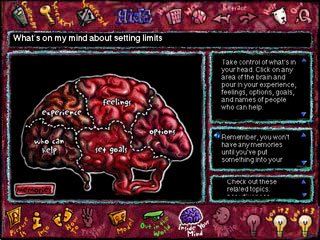 RippleEffects has updated information on their website. This interactive multimedia software, according to the site, helps students succeed by:
"* Providing research-validated and comprehensive positive behavioral interventions and supports (PBIS)
* Easily building individualized interventions to build student's resilience, social and emotional competency, and connection to the community
* Ensuring fidelity to proven effective cognitive-behavioral training methods
* Matching training to each student's learning strengths
* Automatically monitoring student progress – reducing paperwork
Try it: order a risk-free 30 day preview of the full  program."

RippleEffects for Kids RippleEffects for Teens
Links to organizations about grant information for technology.
According to the GLEF's Edutopia website, "our experience has shown that the most successful schools share many common traits. Here, you'll be able to learn more about these key elements and discover how specific schools have put theory into practice. You'll also find a wealth of resources to assist you in your efforts to transform schools"
Edutopia's grant Information page has links to a wide range of organizations that offer technology and related grants to educational institutions. Many of these grants have early deadlines, so if your school's team is interested in looking at these resources, start as soon as you can. Keep in mind that the George Lucas Educational Foundation (GLEF) is not a grant- offering organization. It is a great on-line resource for educators.
Subscribe to:
Posts (Atom)


