Monday, August 16, 2010

"The World Is Open" Book Study Resources (Mega List)- Required reading for principals in my school district!

In my school district, everyone is involved in book studies.  I'm happy to share that the required book for all of the principals this school year is "The World Is Open: How Web Technology Is Revolutionizing Education",  by Curtis J. Bonk.  

I couldn't resist posting the web-based resources for each chapter of the book on my blog!

Chapter 1: WE-ALL-LEARN

Classroom 2.0 Live Conversations: http://www.classroom20wiki.com/live+conversations
The Cool Cat Teacher Blog: http://coolcatteacher.blogspot.com/
Curt Bonk Preso at GAETC " cool: http://www.ustream.tv/recorded/WZTSvHIZeXfI1yejRw8d2w
EdTechTalk: http://www.edtechtalk.com/
EdTechWeekly: http://www.edtechtalk.com/taxonomy/term/130
EdTV (Educational content in Ustream): http://edtv.wikispaces.com/
The K-12 Online Conference 2007: http://k12onlineconference.org/?p=79
Ustream: http://www.ustream.tv/
WebQuest: http://webquest.org/index.php

Alexa: http://www.alexa.com
Cable in the Classroom: http://www.ciconline.org/home
EdTechLive (interviews by Steve Hargadon) http://edtechlive.wikispaces.com/Recordings+List
High Tech High: http://www.hightechhigh.org/
Mahalo: http://www.mahalo.com/
Vote Different: http://youtube.com/watch?v=6h3G-lMZxjo

The Cape Town Open Education Declaration: http://www.capetowndeclaration.org/
Connexions: http://cnx.org/
EDUCAUSE: http://www.educause.edu/
Internet to Everyone: http://internetforeveryone.org/
Open Society Institute: http://www.soros.org/
Shuttleworth Foundation: http://www.shuttleworthfoundation.org/
WikiMedia Foundation: http://wikimediafoundation.org/wiki/Home


Chapter 2: To Search and to Scan (Opener #1: Web Searching in the World of e-Books)

America's Promise Alliance: http://www.americaspromise.org/APA.aspx
Brian J. Ford: http://www.brianjford.com/bjford.htm
CafeScribe: http://www.cafescribe.com/
California Open Source Textbook Project (COSTP): http://www.opensourcetext.org/
Digital History: http://www.digitalhistory.uh.edu/
Ebrary: http://www.ebrary.com/corp/index.jsp
Flat World Knowledge: http://www.flatworldknowledge.com/minisite/
Freeload Press: http://www.freeloadpress.com/navStudents.aspx
Global Text Project: http://globaltext.org/
Google Book Search: http://books.google.com/
Google Earth: http://earth.google.com/
Google Sky: http://earth.google.com/sky/skyedu.html
Hole in the Wall Education: http://www.hole-in-the-wall.com/index.html
Internet Archive: http://www.archive.org/index.php
Kindle (from Amazon): http://www.amazon.com/dp/B000FI73MA/?tag=googhydr-20&ref=pd_sl_p2bg741rk_e
Live Search Books (Microsoft): http://search.live.com/books
Lulu: http://www.lulu.com/
NetLibrary: http://www.netlibrary.com/
OCLC (Online Computer Library Center): http://www.oclc.org/default.htm
Open Content Alliance: http://www.opencontentalliance.org/
Open Library: http://www.openlibrary.org/
Open Society Institute: http://www.soros.org/
The Papers of Thomas Jefferson: http://www.princeton.edu/~tjpapers/declaration/declaration.html
Questia: http://www.questia.com/Index.jsp
Reddit: http://reddit.com/
Shuttleworth Foundation: http://www.shuttleworthfoundation.org/
Sloan Consortium: http://www.sloan-c.org/
Textbook Revolution: http://www.textbookrevolution.org/
The Universal Digital Library (Million Book Collection): http://www.ulib.org/
Wayback Machine: http://www.archive.org/web/web.php
WikiMedia Foundation: http://wikimediafoundation.org/wiki/Home
Wireless Networking in the Developing World: http://wndw.net/index.html
WorldCat: http://www.worldcat.org/

Chapter 3: E-Demand around the Globe (Opener #2: E-Learning and Blended Learning)

Capella University: http://www.capella.edu/
eCollege: http://www.ecollege.com/index.learn
Confucius Institute at Michigan State University: http://confucius.msu.edu/
Electronic Classroom of Tomorrow (ECOT) in Ohio: http://www.ecotohio.org/home.php
Florida Virtual School: http://www.flvs.net/
FreeRice: http://www.freerice.com/index.php
GoArmyEd: https://www.earmyu.com/Login.aspx
Indiana University High School: http://scs.indiana.edu/hs/highschoolcourses.php
Indira Gandhi National Open University: http://www.ignou.ac.in/
Jones International University: http://www.jiu.edu/
K-12 Homeschooling, Inc: http://www.k12.com/
Laureate Education, Inc.: http://www.laureate-inc.com/index.php#
Michigan Virtual University: http://www.mivu.org/
NC Learn and Earn: http://www.nclearnandearn.gov/
North American Council for Online Learning: http://www.nacol.org/
NotSchool: http://www.notschool.net/inclusiontrust.org/Welcome.html
Poverty.com: http://poverty.com/
Ramkhamhaeng University: http://www.ru.ac.th/english/index.html
http://www.ru.ac.th/oasc/oasc_eng/ru_in_brief.htm
Sylvan Learning Systems: http://tutoring.sylvanlearning.com/
TeamSpeak: http://www.goteamspeak.com/
SUNY Network Distance Learning Calculator: http://sln.suny.edu/sln/public/original.nsf/a6b56cc3058e682485256c790066b2d5?OpenForm
U21 Global: http://www.u21global.edu.sg/Education/home
University of Central Florida (enrollments): http://www.iroffice.ucf.edu/character/current.html
University of Maryland University College: http://www.umuc.edu/
University of Phoenix: http://www.phoenix.edu/
University of Phoenix Campus Locations: http://www.phoenix.edu/campus_locations/campus_locations.aspx
Urban Farming: http://www.urbanfarming.org/
Utah Electronic High School: http://www.schools.utah.gov/ehs/
The Voyages of the S/V Roam (includes weblogs of Karen Fennell and her family): http://www.svroam.com/index.html
Walden University: http://www.waldenu.edu/
Western Governors University: http://www.wgu.edu/index.asp
Zon: http://enterzon.com/

Chapter 4: It's a Free Software World After All (Opener #3: Availability of Open Source and Free Software)

Audacity: http://audacity.sourceforge.net/
Celestia: http://www.shatters.net/celestia/
Cmap: http://cmap.ihmc.us/
Colonization: http://www.bestoldgames.net/eng/old-games/colonization.php
Creative Commons: http://creativecommons.org/
Drupal: http://drupal.org/
FreeCol: http://www.freecol.org/
FreeMind: http://freemind.sourceforge.net/wiki/index.php/Main_Page
Freesound Project: http://freesound.iua.upf.edu/index.php
Firefox: http://www.mozilla.com/en-US/firefox/
Gallery: http://gallery.menalto.com/
Google Earth: http://earth.google.com/
Jmol: http://jmol.sourceforge.net/
Lessig blog (Larry Lessig): http://www.lessig.org/blog/
List of Open Source Tools: http://www.debianhelp.co.uk/tools.htm
MediaWiki: http://www.mediawiki.org/wiki/MediaWiki
Moodle: http://moodle.org
Moodle Philosophy: http://docs.moodle.org/en/Philosophy
Ning: http://www.ning.com/
Ning in Education: http://education.ning.com/
Nucleus (blog tools): http://nucleuscms.org/
Open Learning Initiative (Carnegie Mellon University): http://www.cmu.edu/oli/
OpenLearn (UK Open University): http://www.open.ac.uk/openlearn/home.php
Richard Stallman homepage: http://www.stallman.org/
Sakai (http://sakaiproject.org)
Serendipity (blog tools): http://www.s9y.org/
SigTE Book Discussion: Reinventing Project Based Learning: http://sigte2008.ning.com/
SourceForge: http://sourceforge.net/
Stellarium: http://www.stellarium.org/
TikiWiki: http://info.tikiwiki.org/tiki-index.php
Tree of Life: http://tolweb.org/tree/
Visual Understanding Environment (VUE): http://vue.uit.tufts.edu/
Vocabulary Trainer: http://www.vocabularytrainer.net/
WikiEducator: http://www.wikieducator.org/Main_Page


Chapter 5: MIT in Every Home (Opener #4: Leveraged Resources and OpenCourseWare)

The China Open Resources for Education project (www.core.org.cn/en/index.htm).
CORE Mission: http://www.core.org.cn/en/about_core/core_zl.htm
eduCommons: http://cosl.usu.edu/projects/educommons
Foothill Community College OCW: http://foothillglobalaccess.pbwiki.com/Open-Educational-Resources
Google Apps: http://www.google.com/a/help/intl/en/var_1b.html
Hewlett Foundation OER Resources and Grants: http://www.hewlett.org/Programs/Education/OER/openEdResources.htm
Hewlett OER Blog called OERderves: http://www.oerderves.org
Japan OpenCourseWare Consortium: http://www.jocw.jp/index.htm
The Johns Hopkins Bloomberg School of Public Health's OCW: http://www.jhsph.edu/
The Library of Congress American Memory Project: http://memory.loc.gov/ammem/index.html
MIT Lecture Browser: http://web.sls.csail.mit.edu/lectures/
MIT OpenCourseWare (OCS) Course List: http://ocw.mit.edu/OcwWeb/web/courses/courses/index.htm
MIT OpenCourseWare (OCW) Project: http://ocw.mit.edu/index.html
MIT OpenCourseWare (OCW) Highlights for High School: http://ocw.mit.edu/OcwWeb/hs/home/home/index.htm
MIT OpenCourseWare (OCW) Highlights for High School video: http://www.youtube.com/watch?v=qMNWtUs7KoU
MIT OpenCourseWare (videos: Motion in Two Dimensions): http://ocw.mit.edu/OcwWeb/hs/physics/a/2/2.htm
National Program on Technology Enhanced Learning (from seven IIT's in India): http://nptel.iitm.ac.in/
National Program on Technology Enhanced Learning (from seven IIT's in India): http://www.youtube.com/user/nptelhrd
National Program on Technology Enhanced Learning (complete list):
http://www.youtube.com/profile_play_list?user=nptelhrd
OOPS: (http://oops.editme.com)
The Open Knowledge Foundation: http://www.okfn.org/
Open Yale Courses: http://open.yale.edu/courses/
OpenCourseWare Consortium: http://www.ocwconsortium.org/
OpenCulture (blog from Dan Colman): http://www.oculture.com/
OpenCulture (list of free courses): http://www.oculture.com/2007/07/freeonlinecourses.html
OER Commons: http://oercommons.org/
Public Library of Science (www.plos.org)
The Rai Foundation Colleges OCW project in India: http://www.rocw.raifoundation.org/
Teacher lesson plan sites:
The Lesson Plan Page: http://www.lessonplanspage.com/
Sites for Teachers: http://www.sitesforteachers.com
Tufts University's OCW: http://ocw.tufts.edu/
Utah State University OCW: http://ocw.usu.edu/
Vietnam Fulbright Economics OCW: http://ocw.fetp.edu.vn/home.cfm
Yahoo! Teachers: http://teachers.yahoo.com/


Chapter 6: Portals for the People (Opener #5: Learning Object Repositories and Portals)

Acoustics for Music Theory (Catherine Schmidt-Jones): http://cnx.org/content/m13246/latest/
The Alan Turing Home Page: http://www.turing.org.uk/turing/
Armistad Digital Resource (from Columbia University): http://www.amistadresource.org/index.html
Audubon's Birds of Prey: http://digital.library.pitt.edu/a/audubon/
Babelfish: http://babelfish.altavista.com/ and http://babelfish.altavista.com/
Bill and Melinda Gates Foundation: http://www.intel.com/education/
British Library: http://www.bl.uk/
British Library Online Gallery: http://www.bl.uk/onlinegallery/homepage.html
British Library Turning the Pages: http://www.bl.uk/onlinegallery/ttp/ttpbooks.html
Center for History and New Media (George Mason University): http://chnm.gmu.edu/
Cisco Industry Solutions Education: http://www.cisco.com/web/strategy/education/index.html
Cisco Socioeconomic Development: http://www.cisco.com/web/about/citizenship/socio-economic/index.html
Civil Rights Digital Library: http://crdl.usg.edu/voci/go/crdl/home
CNN Video: http://www.cnn.com/video/
The Complete Works of Charles Darwin: http://darwin-online.org.uk/
Connexions from Rice University (http://cnx.rice.edu)
Copyright Office Basics: http://www.copyright.gov/circs/circ1.html
Curriki: http://www.curriki.org/xwiki/bin/view/Main/Browse
Dictionary.com: http://dictionary.reference.com/
DNA From the Beginning: http://www.dnaftb.org/dnaftb/
Einstein Archives Online: http://www.alberteinstein.info/
Encyclopedia of Life: http://www.eol.org/index
Exploring and Collecting History Online (ECHO): http://echo.gmu.edu/
eScholarship Editions: http://content.cdlib.org/escholarship/
eScholarship Publishing Program: http://www.cdlib.org/programs/escholarship.html
eScholarship Repository: http://repositories.cdlib.org/escholarship/
Federal Resources for Educational Excellent project (see http://free.ed.gov/)
The Free Dictionary: http://www.thefreedictionary.com/
Free Management Library: http://www.managementhelp.org/
Free-Reading.net: http://www.free-reading.net/index.php?title=Main_Page
Goddard Space Flight Center: http://www.nasa.gov/centers/goddard/home/index.html
HippoCampus: http://www.hippocampus.org/
IBM Education: http://www.ibm.com/ibm/ibmgives/grant/education/
IBM Transition to Teaching: http://www.ibm.com/ibm/ibmgives/news/transition_to_teaching.shtml
Institute for Advanced Technology in the Humanities:
http://www.iath.virginia.edu/
The Architecture of Thomas Jefferson: http://www2.iath.virginia.edu/wilson/
Mapping of the Dalai Lamas: http://www.iath.virginia.edu/dalai_lamas/
The Melville Electronic Library: http://www2.iath.virginia.edu/melville/
Silk Road: http://www2.iath.virginia.edu/melville/
Walt Whitman Archive: http://www.whitmanarchive.org/
Intel Education Initiative: http://www.intel.com/education/
IUScholarWorlks Repository: https://scholarworks.iu.edu/dspace/
Jorum: http://www.jorum.ac.uk/
KPMG Faculty Portal: https://www.kpmg.com/facultyportal/
Merriam-Webster's Online Dictionary: http://www.m-w.com/
MERLOT: http://conference.merlot.org,
MSN Encarta Dictionary: http://encarta.msn.com/encnet/features/dictionary/dictionaryhome.aspx
Museum of New Zealand Te Papa Tongarewa: http://www.tepapa.govt.nz/Tepapa/English/
Museum of Online Museums: http://www.coudal.com/moom/
NASA Learning Technology site (see http://learn.arc.nasa.gov/)
National Geographic News: http://news.nationalgeographic.com/news/
National Museum of African-American History and Culture: http://nmaahc.si.edu/
Ontario Educational Resource Bank: http://www.elearningontario.ca/eng/bank/Default.aspx
Public Library of Science: www.plos.org
Richard Baraniuk: http://www.dsp.rice.edu/~richb/bio.html
Richard Baraniuk (TED video): http://www.youtube.com/watch?v=RRymi-lFHpE
Squidoo: http://www.squidoo.com/
Stanford Encyclopedia of Philosophy: http://plato.stanford.edu
Valley of the Shadows: http://valley.vcdh.virginia.edu/
Women in Math Project: http://darkwing.uoregon.edu/~wmnmath/
Wikispecies: http://species.wikimedia.org/wiki/Main_Page
Worldmapper: http://www.worldmapper.org/display.php?selected=174
Yahoo! Education: http://education.yahoo.com/
Yahoo! Teachers: http://teachers.yahoo.com/
YourDictionary: http://www.yourdictionary.com/


Chapter 7: Making a Contribution (Opener #6: Learner Participation in Open Information Communities)

A Closer Look At the iPhone
http://youtube.com/watch?v=YgW7or1TuFk
An Anthropologist Explores YouTube: http://chronicle.com/media/video/v53/i36/youtube/
A Vision of Students Today: http://www.youtube.com/watch?v=dGCJ46vyR9o
African School Dream (CurrentTV): http://www.current.tv/watch/21491875?s1=topVids&list=topVidsByAssignmentDesk&filterone=&filtertwo=&sid=21491875&fr=0
Anystream (Apreso): http://www.anystream.com/
Big Think: http://www.bigthink.com/
Boing Boing: http://www.boingboing.net/
Britanica.com: http://www.britannica.com/
Bud Hunt's weblog: http://budtheteacher.typepad.com/
Charlie the Unicorn (YouTube): http://youtube.com/watch?v=Q5im0Ssyyus
Chinswing: http://www.chinswing.com/
Citizendium: http://en.citizendium.org/wiki/Main_Page
Colour changing card trick: http://www.youtube.com/watch?v=voAntzB7EwE
Common Craft: http://www.commoncraft.com/
Confessions of an ACA Fan: The Official Weblog of Henry Jenkins: http://www.henryjenkins.org/index.html
Cory Doctorow's Homepage (Craphound): http://craphound.com/bio.php
CurrentTV: http://www.current.tv/
Dangerously Irrelevant: weblog by Scott McLeod: http://www.dangerouslyirrelevant.org/
David Warlick's weblog: http://davidwarlick.com/2cents/
Defense Language Institute Foreign Language Center: http://www.dliflc.edu/
Del.icio.us: http://del.icio.us/
Deloiotte Film Festival (Behind the Scenes): http://www.youtube.com/watch?v=Wfx6-5aDaUE
Did You know; Shift Happens " Globalization; Information Age
http://youtube.com/watch?v=ljbI-363A2Q
Did You Know 2.0 (YouTube):http://youtube.com/watch?v=pMcfrLYDm2U
Digg: http://digg.com/
Digital Ethnography at the University of Kansas (Professor Michael Wesch): http://mediatedcultures.net/ksudigg/
Diigo: http://www.diigo.com/
DoFlick: http://www.doflick.com/
Dotsub: http://www.dotsub.com/
DropSend: http://www.dropsend.com/
Education Channel: http://www.independentsfilmfest.com
The Fischbowl: http://thefischbowl.blogspot.com/2007/06/did-you-know-20.html
Frank Caliendo " Impressions (YouTube): http://youtube.com/watch?v=kAMIlPudalQ
Free Hugs Campaign (YouTube): http://youtube.com/watch?v=vr3x_RRJdd4
Freebase: http://freebase.com/
FreeSound (from Jack Kerouac project) http://freesound.iua.upf.edu/usersViewSingle.php?id=212155
Free Thesis Project (Harvard College Free Culture group): http://www.hcs.harvard.edu/thesis/repo/
Full Circle Associates: http://www.fullcirc.com/
The Future of the Internet—And How to Stop It by Jonathan Zittrain (e-book site):
http://futureoftheinternet.org/
Gerald Kane (Boston College): http://www.socialtext.net/cim/index.cgi
Gerald Kane's Computers in Management class (Boston College): http://www.socialtext.net/cim/index.cgi
Global Nomads Group (GNG): http://www.gng.org/home.html
Global Nomads Group (GNG) special video with Michael Douglas narrating: http://www.gng.org/ml/library.php?movieid=44
Guitar (YouTube): http://youtube.com/watch?v=QjA5faZF1A8
Hahaha (YouTube): http://youtube.com/watch?v=5P6UU6m3cqk
HyperHistory: http://www.hyperhistory.com/online_n2/History_n2/a.html
iCue: http://www.icue.com
Inspiration: http://www.inspiration.com/
The Institute for the Future of the Book: http://www.futureofthebook.org/
International Studies for International Schools: http://crlt.indiana.edu/isis/ISIS_About%20ISIS.htm
Internet Time Group in Scribd: http://www.scribd.com/groups/view/5620-internet-time-group
Introducing the book (repost) (YouTube): http://youtube.com/watch?v=xFAWR6hzZek
Jack Kerouac's America: http://www.jackkerouacwrotehere.com/
John Dewey: American Pragmatist: http://dewey.pragmatism.org/
Juhasz Final Video (Alexandra Juhasz class reflection): http://www.youtube.com/watch?v=YnmEKEG-vn8
Learning from the Tube (Pitzer College): http://www.youtube.com/group/learningfromyoutube
Leonardo DiCaprio's YouTube Message (YouTube): http://youtube.com/watch?v=9OhdMULRkAs
Longitude: http://www.golongitude.org/
Longitude (CurrentTV): http://www.current.tv/watch/33512311?s1=topVids&list=topVidsByAssignmentGroup&filterone=0&filtertwo=0&sid=33512311&fr=14
Knol sample screenshot: http://www.google.com/help/knol_screenshot.html
KnolStuff.com: http://knolstuff.com/
LibraryThing: http://www.librarything.com/
Malcolm X: Oxford University Debate (YouTube): http://youtube.com/watch?v=Dmzaaf-9aHQ&mode=related&search
Media Praxis: weblog from Alexandra Juhasz: http://aljean.wordpress.com/
Metaweb Technologies: http://www.metaweb.com/
Michael J. Fox (YouTube video on stem cell research) (YouTube): http://youtube.com/watch?v=a9WB_PXjTBo
Millennium Project: http://www.unmillenniumproject.org/press/g8overview.htm
Mojiti: http://mojiti.com/
MusicBrainz: http://musicbrainz.org/
Noah takes a photo of himself every day for 6 years (YouTube): http://youtube.com/watch?v=6B26asyGKDo
NomadsLand: http://nomadsland.com/
OK Go Here It Goes Again (YouTube): http://youtube.com/watch?v=pv5zWaTEVkI
Panopto (Socrates Project and Carnegie Mellon University): http://www.panopto.com/
Pay Attention (YouTube): http://youtube.com/watch?v=aEFKfXiCbLw
Pay Attention (TeacherTube): http://www.teachertube.com/view_video.php?viewkey=40c570a322f1b0b65909
Quirkology: http://www.quirkology.com/
Research Channel: http://www.researchchannel.org/prog/
Richard Wiseman:
http://www.richardwiseman.com/
Robert Redford on Saving the Artic Refuge (YouTube): http://youtube.com/watch?v=ewbHBJkhz6g
Ronaldinho: Touch of Gold (YouTube): http://youtube.com/watch?v=lsO6D1rwrKc
Rosetta Stone: http://www.rosettastone.com/
The Royal Channel: http://www.youtube.com/user/TheRoyalChannel
SciVee: http://www.scivee.tv/
SchoolTube: http://www.schooltube.com/
Scrapblog: http://scrapblog.com/
Scribd: http://www.scribd.com/
SEC Archives: http://www.sec.gov/cgi-bin/srch-edgar
Main Search Page: http://www.sec.gov/edgar/searchedgar/webusers.htm
Sega, Ghana James weblog: http://segaghana.blogspot.com/
ShiftHappens (wikispaces): http://shifthappens.wikispaces.com/
Slashdot: http://slashdot.org/
SnapGenie: http://www.snapgenie.com/
Sonic Foundry (Mediasite Live): http://www.sonicfoundry.com/solutions/higher_education.aspx
Spiders on Drugs (YouTube): http://youtube.com/watch?v=sHzdsFiBbFc
SplashCast: http://web.splashcast.net/
Stride Gum: http://www.stridegum.com/
StumbleUpon: http://www.stumbleupon.com/
TeacherTube: http://www.teachertube.com/
Tegrity: http://www.tegrity.com/
The Wealth of Networks: How Social Production Transforms Markets and Freedom by Yochai Benkler (e-book site): http://www.benkler.org/wealth_of_networks/index.php?title=Main_Page
This Week in Tech (TWIT) Netcast: http://www.twit.tv/
Tibet Snapshots (NomandsLand):
http://link.brightcove.com/services/link/bcpid823331442/bclid331394380/bctid1143371806
TravelinEdMan weblog (Curt Bonk): http://travelinedman.blogspot.com/
Twitter in Plain English (with dotSUB):
http://dotsub.com/films/twitterin/index.php?autostart=true&language_setting=en_3068
YackPack: http://www.yackpack.com/
Yale University Press: http://yalepress.yale.edu/home.asp
UChannel: http://uc.princeton.edu/main/
YouTube Channels:
American University of Beruit: http://www.youtube.com/user/AUBatLebanon
Northwestern University: http://youtube.com/NorthwesternU
University of California at Berkeley:http://www.youtube.com/ucberkeley
University of New South Wales: http://www.youtube.com/user/unsw
University of Southern California (YouTube Channel): http://www.youtube.com/usc
Video: RSS in Plain English
http://youtube.com/watch?v=0klgLsSxGsU
VoiceThread: http://voicethread.com/
Vote Different (Hillary Clinton) (YouTube): http://youtube.com/watch?v=6h3G-lMZxjo
Web 2.0 The Machine is Us/ing Us (YouTube): http://youtube.com/watch?v=6gmP4nk0EOE
We-blogged Will Richardson's weblog: http://www.weblogg-ed.com/
Where in Google Earth is Matt? http://www.youtube.com/watch?v=BJbNuKvp0dY
Where the Hell Is Matt website: http://www.wherethehellismatt.com/
Where the Hell is Matt? (YouTube): http://youtube.com/watch?v=bNF_P281Uu4
Where the Hell is Matt? (2008) (YouTube): http://www.youtube.com/watch?v=zlfKdbWwruY&feature=related
Where the Hell WAS Matt? (YouTube): http://youtube.com/watch?v=7WmMcqp670s&mode=related&search=
Where the Hell are Matt's Outtakes: http://youtube.com/watch?v=tT8jA_pps3o&mode=related&search=
Wikia Search: http://re.search.wikia.com/index.html
Wikibooks: http://en.wikibooks.org/wiki/Main_Page
Wikis in Plain English (YouTube): http://youtube.com/watch?v=-dnL00TdmLY
Wikijunior: http://en.wikibooks.org/wiki/Wikijunior
Wikispaces: http://www.wikispaces.com/
Wikispaces: 21st century learning edubloggers: http://21stcenturylearning.wikispaces.com/page/xml/Edubloggers?v=rss_2_0
Wikia: http://www.wikia.com/wiki/Wikia
The World Bank - Business Unusual: BPO in Ghana: http://youtube.com/watch?v=1MD51rXfFOQ
World Simulation Video: http://mediatedcultures.net/ksudigg/?p=117
World Simulation Preview for 2007 (YouTube): http://youtube.com/watch?v=SXnWmu6xdpc


Chapter 8: Collaborate or Die! (Opener #7: Electronic Collaboration and Interaction)

1001 Flat World Tales (blog of award winning stories): http://1001flatworldtales.edublogs.org/
1001 Flat World Tales (wiki): http://ms1001tales.wikispaces.com/
1kg: http://www.1kg.org/
Alpha Plus Center: http://distance.alphaplus.ca
Ask Dr. Math: http://mathforum.org/dr.math/
Ask a Scientist: http://www.madsci.org/submit.html
Club Penguin: http://www.clubpenguin.com/
Collanos: http://www.collanos.com/
Contact North: http://www.cnorth.edu.on.ca/
Digiteens: http://digiteen.wikispaces.com/
Dimdim: http://www.dimdim.com/
Edutopia: http://www.edutopia.org/
E-Learning Journeys (Julie Lindsay's Weblog for the Flat Classroom Project): http://123elearning.blogspot.com/
Elluminate: http://www.elluminate.com/
ePals: http://www.epals.com/
Evoca: http://www.evoca.com/
Exploratorium: http://www.exploratorium.edu/
Flat Classroom Project (in Wikispaces): http://flatclassroomproject.wikispaces.com/
Flat Classroom Project (in Ning): http://flatclassroomproject.ning.com/
GLOBE (Global Learning and Observations to Benefit the Planet) Project: http://www.globe.gov/r?lang=en&nav=1
Google Groups: http://groups.google.com
Google Docs and Spreadsheets: http://docs.google.com/#
GoogleTalk: http://www.google.com/talk/
Horizon Project 2008: http://horizonproject2008.wikispaces.com/
Ice Stories: http://icestories.exploratorium.edu/dispatches/index.php
Ice Stories (Cassandra Brooks' weblog): http://icestories.exploratorium.edu/dispatches/?author=6
iEARN: http://www.iearn.org/
In2Books: http://www.in2books.com/
InnoCentive: http://www.innocentive.com/
International Children's Digital Library: http://www.childrenslibrary.org/index.shtml
The Journey North: http://www.learner.org/jnorth/
Kids as Global Scientists: http://www-personal.umich.edu/~mlhartma/kgs.html
Knowledge Builder: https://www.kb2020.com/contact_us/
Knowledge Forum: http://www.knowledgeforum.com/
Learning Microsoft to Change the World (book by John Wood of Room to Read): http://www.leavingmicrosoftbook.com/
Microsoft Live Office: http://workspace.officelive.com/
Microsoft Office Groove: http://office.microsoft.com/en-us/groove/FX100487641033.aspx
Microsoft Office Sharepoint Server: http://www.microsoft.com/sharepoint/default.mspx
MSN Groups: http://msnusers.com
MyEnglish: https://www.kb2020.com/products_and_services/
MyFreeEnglish: www.myfreeenglish.com
Ning: http://www.ning.com/
Odeo: http://odeo.com/inbox
The Ontario Research and Innovation Optical Network: http://www.orion.on.ca/
Planview: http://www.planview.com/
Podomatic: http://www.podomatic.com/
Room to Read: http://www.roomtoread.org/index.html
Skype: http://www.skype.com/
SurveyMonkey: http://www.surveymonkey.com/Default.aspx
SurveyShare: http://www.surveyshare.com/
Teleportac: http://www.teleportec.com/
Twinbooks: http://www.twinbooks.cn/
Wikinomics: http://www.wikinomics.com/index.php
Wikinomics Playbook: http://www.socialtext.net/wikinomics/index.cgi?wikinomics
Yahoo! Groups: http://groups.yahoo.com
Zoomerang: http://www.zoomerang.com/


Chapter 9: Who are you? (Opener #8: Alternative Reality Learning)

America's Army: http://www.americasarmy.com/
Ask Dr. Math: http://mathforum.org/dr.math/
Ask Dr. Universe: http://www.wsu.edu/DrUniverse/
Ask a Mad Scientist: http://www.madsci.org/
Berkman Center for Internet & Society: http://cyber.law.harvard.edu/
Biz/ed: http://www.bized.co.uk/index.htm
Call of Duty: http://www.callofduty.com/
Charles and Rebecca Nesson discuss CyberOne: http://www.youtube.com/watch?v=ilS_lgWcWeE&feature=related
Cells alive!: http://www.cellsalive.com/
Chemistry Online (University of Oxford): http://www.chem.ox.ac.uk/it/
Civilization: http://www.civilization.com/
CyberOne: Law in the Court of Public Opinion: http://blogs.law.harvard.edu/cyberone/
Demonstration of the Interactive T-account: http://www.youtube.com/watch?v=eJ2870PSUtA
Educational Uses of Second Life: http://www.youtube.com/watch?v=qOFU9oUF2HA
Electronic Arts (EA): http://www.ea.com/language
Eon (Charles Nesson's weblog): http://blogs.law.harvard.edu/nesson/
EVE Online: http://www.eve-online.com/
EverQuest: http://everquest.station.sony.com/
EverQuest II: http://everquest2.station.sony.com/
Final Fantasy XI: http://www.playonline.com/ff11us/index.shtml
Firaxis (has product Civilization): http://www.firaxis.com/games/game_detail.php?gameid=6
Full Spectrum Warrior: http://www.fullspectrumwarrior.com/
Global Kids: http://www.globalkids.org/
Global Kids' Digital Media Initiative: http://holymeatballs.org/second_life/
General Chemistry Online: http://antoine.frostburg.edu/chem/senese/101/index.shtml
Halo 2: http://www.xbox.com/en-US/games/h/halo2/
Halo 3: http://www.halo3.com/
Harvard Business School Cases: http://harvardbusinessonline.hbsp.harvard.edu/b02/en/cases/cases_home.jhtml
Historic Coventry Timeline: http://www.historiccoventry.co.uk/main/timeline.php
Humana Games: http://www.humanagames.com
http://www.humanagames.com/#/experience/
Intellagirl (Sarah Robbins): http://www.intellagirl.com/
IrYdium Project (online chemistry): http://iry.chem.cmu.edu/irproject/
IT Manager Game 2.0 (from Intel): http://itmg2.intel.com/eng/
IvyGate: Harvard Prof. Charles Nesson Is Insane: http://www.youtube.com/watch?v=ZUNAhzwZkdU
Kaneva: http://www.kaneva.com/
Lab Physics: http://lab-physics.com/
Lineage: http://www.lineage2.com/
Lively: http://www.lively.com/html/landing.html
Lyryx Learning: http://lyryx.com/lyryx_interactive.php
MacArthur Foundation (Digital Media and Learning Project): http://digitallearning.macfound.org/site/c.enJLKQNlFiG/b.2029199/k.BFC9/Home.htm
MedCases: http://www.medcases.com/Physician/cme_portal.asp
Metal of Honor: Heroes 2: http://www.ea.com/mohheroes2/
The National Budget Simulation: http://www.nathannewman.org/nbs/
Net Frog: http://curry.edschool.virginia.edu/go/frog/
Parsons School of Design: http://www.parsons.edu/
Pew Internet & American Life Project: http://www.pewinternet.org/
Physics Education Technology (University of Colorado at Boulder): http://phet.colorado.edu/new/index.php
Real-time case method: http://www.sloan-c.org/effective/details2.asp?ACC_ID=32
Really Engaging Accounting (Steven Hornik's weblog): http://www.mybloglog.com/buzz/community/reallyengagingaccounting/
Rome Reborn 1.0: http://www.romereborn.virginia.edu/
Second Life: http://secondlife.com/
SimTeacher: http://www.simteacher.com/
SimCitySocieties: http://simcitysocieties.ea.com/
SmallWorlds: http://www.smallworlds.com/login.php
Sony Computer Entertainment: http://www.scei.co.jp/index_e.html
Spore: http://www.spore.com/
Star Wars Galaxy: http://starwarsgalaxies.station.sony.com/players/index.vm
Storygeek (Mark Bell's weblog): http://www.storygeek.com/
SL 3-D Accounting Model: http://www.youtube.com/watch?v=4T4zTStVK6Y
There.com: http://www.there.com/
UberNoggin (Sarah Robbins' weblog): http://www.ubernoggin.com
Ultima Online: http://www.uoherald.com/news/
Ultima Online: Kingdom Reborn: http://www.uoherald.com/kingdomreborn/
Virtual Chemistry: http://www.chem.ox.ac.uk/vrchemistry/
Virtual Labs and Simulations: http://www.hazelwood.k12.mo.us/~grichert/sciweb/applets.html
Voltage Circuit Simulator: http://jersey.uoregon.edu/vlab/Voltage/
World of Warcraft: http://www.worldofwarcraft.com/index.xml
Will Wright; Toys that Make Worlds (TED Talk): http://www.ted.com/index.php/talks/view/id/146
WisdomTools: http://wisdomtools.com/
Zuckermans Rant (discussion with Charles Nesson): http://www.youtube.com/watch?v=T_akmmr0ReI


Chapter 10: U-Learning? (Opener #9: Real-Time Mobility and Portability)

Abilene Christian University: http://www.acu.edu/
Center for Internet Addiction Recovery: http://www.netaddiction.com/
Chumby: http://www.chumby.com/
CNN Student News: http://www.cnn.com/studentnews/
ComVu: http://www.comvu.com/
Connected (Part 1 of 2) from Abilene Christian University: http://www.youtube.com/watch?v=Tp8fHgp0xhU
Connected (Part 2 of 2) from Abilene Christian University: http://www.youtube.com/watch?v=TLCTpX3tJEQ&feature=related
Covenant Eyes (Internet Addictions and Accountability): http://www.covenanteyes.com/addictionsigns_old.php
Cyworld (South Korea): http://www.cyworld.com/main2/index.htm
Cyworld (US): http://us.cyworld.com/
Flip Video: http://www.theflip.com/products.shtml
Google Earth: http://earth.google.com/
Google Lively: http://www.lively.com/html/landing.html
Google Maps: http://maps.google.com/
Habitat for Humanity: http://www.habitat.org/
International Telecommunications Union: Digital Opportunity Index (DOI): http://www.itu.int/ITU-D/ict/doi/index.html
James Moore (CAP and Livescribe): http://condor.depaul.edu/~jmoore/blogger/2008/07/cap-and-livescribe.html
Kinjo Podwalk: http://podwalk.kinjo-u.tv/
Korean Education and Research Information Services (KERIS) http://english.keris.or.kr/es_main/index.jsp
Livescribe (Pulse smartpen): http://www.livescribe.com/
The Masie Center (3-minute video of the Chumby): http://www.masieweb.com/chumby
Mixi: http://mixi.jp/
Mobile ESL (from Athabasca University): http://www.eslau.ca/
One Laptop Per Child (OLPC): http://laptop.media.mit.edu
Open Knowledge Initiative: http://www.okiproject.org/
Playaway: http://store.playawaydigital.com/
Pocket School Project (from Dr. Paul Kim): http://www.stanford.edu/~phkim/project/consulting.html
Shakespeare's Global Globe: http://www.orbismundi.org/
Virtual-Addiction.com: http://www.virtual-addiction.com/
Voice of America Special English: http://www.voanews.com/specialenglish/
Wireless@SG: http://www.infocomm123.sg/view.123?page=wirelessmain
World Cyber Games: http://www.worldcybergames.com/6th/main.asp


Chapter 11: Learning at Your Service (Opener #10: Networks of Personalized Learning)

AskOnline: http://www.askonline.net/
Audible: http://www.audible.com/
Australia Flexible Learning Framework: http://www.flexiblelearning.net.au/flx/go
Bebo: http://www.bebo.com/
Blogger: http://www.blogger.com/
Business Opportunities Weblog (Dane Carlson's weblog for small business): http://www.business-opportunities.biz/
Business Pundit (Robert May's weblog for business): http://www.businesspundit.com/
The Carlyle Letters Online: http://carlyleletters.dukejournals.org/
Connectivism: http://www.connectivism.ca/
Cyworld: http://us.cyworld.com/
Del.icio.us: http://del.icio.us/
The Diary of Samuel Pepys: http://www.pepysdiary.com/
Diaryland: http://www.diaryland.com/
Emerging Perspectives on Learning, Teaching, and Technology (Michael Orey): http://projects.coe.uga.edu/epltt/index.php?title=Main_Page
Explorer's Web: http://www.explorersweb.com/
Facebook: http://www.facebook.com/
Flickr: http://www.flickr.com/
Flixster: http://www.flixster.com/
Fotolog: http://www.fotolog.com/
Frenchpod: http://frenchpod.com/
Friendster: http://www.friendster.com/
Furl: http://www.furl.net/
Google Blog Search: http://blogsearch.google.com/
Growing Stars: http://www.growingstars.com/
Here Comes Everybody (Ken Carroll's weblog): http://ken-carroll.com/
Hi5: http://hi5.com/
Incheon Free Economic Zone (FEZ): http://eng.ifez.go.kr/guide/ifez_about/ifez.asp
Instapundant (Glenn Reynolds' weblog): http://www.instapundit.com/
Internet Time Blog (Jay Cross's weblog): http://internettime.com/
Learning Peaks: http://www.learningpeaks.com/
LinkedIn: http://www.linkedin.com/
Live Journal: http://www.sixapart.com/livejournal/
Livemocha: http://www.livemocha.com/
Living Tongues Institute for Endangered Languages: http://www.livingtongues.org/
MentorNet: http://www.mentornet.net/
Mixi: http://mixi.jp/
Mixxer (Language Exchange): http://www.language-exchanges.org/
MonkeySee: http://www.monkeysee.com/
Movable Type: http://www.sixapart.com/movabletype/
MySpace: http://www.myspace.com/
New Technology High Schools: http://www.newtechfoundation.org/
Ning: http://www.ning.com/
Old Daily (Stephen Downes): http://www.downes.ca/news/OLDaily.htm
Periodic Table of Visualization: http://www.visual-literacy.org/periodic_table/periodic_table.html
PhotoBucket: http://photobucket.com/
Picasa: http://picasa.google.com/
Pitas: http://www.pitas.com/
Project Gutenberg: http://www.gutenberg.org/wiki/Main_Page
Simpy: http://www.simpy.com/
Small Business Trends (Anita Campbell's weblog): http://www.smallbiztrends.com/
Sookmyung Women's University: http://e.sookmyung.ac.kr/
Stephen's Web (Steven Downes weblog for education): http://www.downes.ca/
SMARTHINKING: http://smarthinking.com/
StraighterLine: http://straighterline.com/
Technorati: http://technorati.com/
The Poles: http://www.thepoles.com/
Thorsmark (Mark Franek's weblog): http://markfranek.wordpress.com/
TravelinEdMan (Curt Bonk's blog): http://travelinedman.blogspot.com/
Triple Creek: http://www.3creek.com/
Tutor.com: http://www.tutor.com/
TutorVista.com: http://www.tutorvista.com/
TypePad: http://www.sixapart.com/typepad/pricing
VoiceThreads: http://voicethread.com/
Visual Thesaurus: http://www.visualthesaurus.com/
Weblogg-ed (Will Richardson's weblog for education): http://www.weblogg-ed.com/
Wikihow: http://www.wikihow.com/Main-Page
William Penn Charter School: http://www.penncharter.com/root.asp?display=flash
Xanga: http://www.xanga.com/

Language Learning:

Adout.com: Education: http://www.about.com/education/
Childtopia: http://www.childtopia.com/
ChinesePod: http://chinesepod.com/
Chinswing: http://www.chinswing.com/
Dave's ESL Café: http://www.eslcafe.com/
ECpod: http://www.ecpod.com/
EnglishPod: http://www.englishpod.com/
Englishtown: http://www.englishtown.com/Sp/lp/Home.aspx?bhcp=1
ESL Flashcards: http://www.eslflashcards.com/
ESL Kids: http://www.esl-kids.com/
FriendsAbroad: http://www.friendsabroad.com
FrenchPod: http://frenchpod.com/
Global English: http://www.globalenglish.com/pls/EN/225474.htm
ItalianPod: http://italianpod.com/
KanTalk: http://www.kantalk.com/
LanguageLab.com: http://www.languagelab.com/index/
Livemocha: http://www.livemocha.com/
LoMasTv: http://lomastv.com/product/home.php?
Mango Languages: http://www.mangolanguages.com/
Mixxer: http://www.language-exchanges.org/
Rosseta Stone: http://www.rosettastone.com/
SpanishPod: http://spanishpod.com/

Podcasting and Vodcasting:

Curry.com (Adam Curry's weblog): http://www.curry.com/
Daily Source Code (from Adam Curry): http://www.dailysourcecode.com/
Digital Podcast: Education Podcast Directory: http://www.digitalpodcast.com/browse-educational-20-1.html
EdTechTalk: http://edtechtalk.com/
The Education Podcast Network (EPN): http://epnweb.org/
iTunes: http://www.apple.com/itunes/
iTunes U: http://www.apple.com/education/itunesu_mobilelearning/itunesu.html
Learning 2006 University (from Elliott Masie): http://www.learning2006.com/university
NPR podcast directory (Beta):
http://www.npr.org/rss/podcast/podcast_directory.php
Podcast Alley: http://www.podcastalley.com/
Podcasting News: http://www.podcastingnews.com/
Podcast.com: http://podcast.com/
SonoSite ultrasound training: http://www.sonosite.com/trainingmodules/
Worldbridges: http://worldbridges.net/


Chapter 12: The Treasures and Traps of this Open Learning World

American Sign Language (Michigan State University): http://commtechlab.msu.edu/sites/aslweb/
Carnegie Mellon University Open Learning Initiative: http://www.cmu.edu/oli/
Computer Aided Language Instruction Group (University of Arizona Turkish Lessons): http://cali.arizona.edu/maxnet/tur/
Connectivism: http://www.connectivism.ca/about.html
Conversational Mandarin Chinese (California State Long Beach): http://www.csulb.edu/~txie/ccol/content.htm
eLearningspace: Everything E-learning (articles from George Siemens): http://www.elearnspace.org/Articles/index.htm
Johns Hopkins Bloomberg School of Public Health: http://ocw.jhsph.edu/
Knowing Knowledge (George Siemen's weblog): http://www.knowingknowledge.com/
MIT OpenCourseWare Initiative: http://ocw.mit.edu/OcwWeb/index.htm
North Carolina Center for Public Health Preparedness: http://nccphp.sph.unc.edu/training/
Turkish Studies, Department of Near Asia Studies (University of Arizona): http://nes.web.arizona.edu/turkish/

AcademicTermPapers.com: http://www.academictermpapers.com/
ALT-C 2007: http://www.alt.ac.uk/altc2007/keynotes.html
CheatingHouse.com: http://www.cheathouse.com/
Commonwealth of Learning: http://www.col.org/colweb/site/pid/1
Digital Research Tools: http://digitalresearchtools.pbwiki.com/
Diploma Makers: http://www.diplomamakers.com/
Dying Professor's Last Lecture: http://www.youtube.com/watch?v=ZQtwEKlUutA
FakeDegrees.com: http://www.fakedegrees.com/
Google Talk: http://www.google.com/talk/
The Last Lecture Book by Dr. Randy Pausch is in Stores Now: http://www.youtube.com/watch?v=PhLCnzePIaw
Phony Diplomas: http://www.phonydiploma.com/
Pink Monkey: http://www.pinkmonkey.com/
Plato's Republic (in Scribd): http://www.scribd.com/word/embed/9318?slag=PlatoThe-Republic-Rationalist-Philosophy
Randy Pausch Last Lecture: Achieving Your Childhood Dreams: http://www.youtube.com/watch?v=ji5_MqicxSo&feature=related
Randy Pausch Inspires Graduates: http://www.youtube.com/watch?v=RcYv5x6gZTA&feature=user
Skype: http://www.skype.com/
Top Term Papers: http://www.top-term-paper-sites.com/#ranked
Turnitin: http://turnitin.com/static/home.html

Tuesday, August 03, 2010

Video clips that help students with autism learn and feel calm at the same time!

One of the schools I serve as a school psychologist has a number of students with severe autism.  Over the past year or so, each classroom was outfitted with a new interactive white board (IWB). We've found that multimedia content displayed on these large screens is much more engaging than what is viewed on computers with much smaller displays.

The exciting news is that some of the students who have minimal interest in computers pay a great deal of attention to activities on the IWBs.  Students who have self-stimulatory or repetitive behaviors that interfere with their ability to engage in traditional activities don't seem to exhibit these patterns nearly as much when the focus is on the IWB.   In my opinion, IWBs are great tools for reaching and teaching young people who have autism spectrum disorders!

I'm in the process of creating a variety of short video clips that teachers can embed in learning activities that also provide a way for students to reduce their levels of anxiety, agitation, and/or repetitive behaviors.

The following videos are my first experiments, and are not as polished as I'd like.  They are best viewed on a large-screen display or IWB, set to high definition.  Although various students have viewed these videos a few times this week, they were a great hit. In some cases, we found it useful to loop the video, especially for students who require repetition of content.

The videos were shot using a small hand-held Panasonic HD camcorder, and quickly edited in iMovie. The music was either taken from the iMovie music library or created using riffs in Garage Band, an Apple iLife product.

Enjoy!

Lily Pond and Music

In this video, I used a few subtitles to direct the viewer to points of interest, such as the little grasshopper hiding in the pink lily and a dragonfly, which appears near the end of the video.

Butterflies and Flowers Set to Music

I set this version to piano music for a student who listens to piano music as a coping strategy. I plan to create another version with other genres of music. This particular score was created with piano riffs from Garage Band.


Up Close at the Charleston Aquarium - with relaxing music

Even the most inattentive students paid maximum to this video when it was looped!  I think they liked the variety of sea life, especially the turtles.  Tip:  If you plan to capture video at an aquarium, plan to visit at a time where there are few visitors!

I can't wait to take my video camera to the Atlanta aquarium.

Minnows and Music


The minnows swimming around in the murky green tank are a little boring, but things get slightly more exciting when the bait-shop owner feeds them. The music makes up for what the video lacks. The students didn't mind at all.


Jellyfish at the Discovery Place Aquarium, Charlotte, NC - with music

I'd like to visit Discovery Place at a less-crowded time and re-capture the jellyfish in action from a better vantage point.

"Cute Doggies" Photo-Globe Mash-up using Google Earth and a Flickr Set (How-to)

If you have access to an interactive whiteboard, such as a SMARTBoard, and want to try something a little different, you might want to try your hand at creating a themed-based "mash-up" for students. The photo below is a screen shot of photos of just about every dog I know, and some that happened to cross my path. In this post, I'll share some information about how to create a photo-globe in Google Earth.  I'll post a "how-to" video in the future.


The first step is to make sure you have lots of pictures related to your theme uploaded to a site such as Flickr.  (You can also create a photo-globe using pictures from your computer's hard drive.)

To get the pictures into Google Earth, I used the Image Overlay feature, and in the "link" textbox, I entered the image URL for each picture that I'd previously loaded as a set in Flickr.

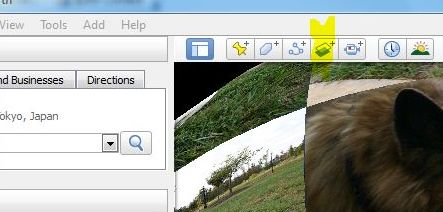
To do prepare for this, make sure you go to "view" tab on the upper left-hand section of your screen, and make sure that "toolbar" is checked. Also make sure that "Grid" is selection, as this will help make it easier to arrange and align your pictures.  You can turn off this feature later. Near the top of the screen, click on the Image Overlay icon. (I've highlighted it in the picture.)


You'll have to enter the URL of the image you'd like to add to the globe in the "Link" textbox, which I've highlighted in the above picture.  In this case, I've used a link to one of my pictures in a Flickr set I created for this project.

One thing to keep in mind is that the picture will take up a much larger space than you might prefer, so you'll have to adjust the size using the green markers:

Positioning the Overlay in the Viewer
The following directions are from the "Positioning the Imagery in the Viewer" section in the help section:

  1. Use the center cross-hair marker to slide the entire overlay on the globe and position it from the center. (Tip: do this first.)
  2. Use the triangle marker to rotate the image for better placement.
  3. Use any of the corner cross-hair markers to stretch or skew the selected corner. If you press the Shift key when selecting this marker, the image is scaled from the center.
  4. Use any of the four side anchors to stretch the image in or out of from the selected side. If you press the Shift key when doing this, the image is scaled from the center.

TIP:  Try positioning the center of the image as a reference point first, and then use the Shift key in combination with one of the anchors to scale the image for best positioning.


In Flickr,  to get the image URL, go to the "share this" tab above the picture you'd like to put on the globe. You need to select the one that says "Grab the HTML", as shown below:

Select ONLY the code that comes after "src=" and before "width".

Then repeat. You can add place-marks that contain URLs that link to additional information about the subject of a picture, such as blog posts with embedded videos and/or text related to a picture, and so forth.

The process of building a photo-globe in Google Earth is a bit tedious.  If someone has a short-cut to share, please let me know!


TAG GALAXY - A "shortcut":
If you have a burning desire to create a quick photo-globe using random pictures, you see what the Tag Galaxy has to offer.  Enter "dogs" or whatever theme you want for your photo-globe, and in an instant, it will be created from publicly available pictures from Flickr. The application uses the Flickr API.

Here is an example of a "Dog" Tag Galaxy:
You can spin the Tag Galaxy globe by using a mouse, or if you have a touch screen computer or a SMARTBoard, with your fingers.

Here is the slideshow from the pictures selected for the photo-globe:


Why is this important to me?
The students at one of my schools started back last week, due to the school's "year-round" schedule. The students in this program have multiple special needs, including severe autism, and most learn best through visual and multimedia representations of information. I devote some of my spare time creating interactive content for the students, and I thought this might work out nicely.

To address the student's special learning needs, a number of new SMARTBoards were recently installed at the school, and now every classroom has an interactive whiteboard, including the room I usually use with students. We also have a few Dell Studio One All-in-One touch screen computers and a multi-touch SMARTTable.  Interactive multimedia content works nicely on these screens! (I'm planning on making a "how-to" video when I get the chance.)

RESOURCES
Google Earth
Flickr
Programmable Web (My hunch is that this site might provide some information about shortcuts for creating a photo-globe in Google Earth.)
(Cross posted on the Interactive Multimedia Technology Blog)

Monday, July 12, 2010

New at SMART Technologies: 3D-Ready SMART Board 600i, Mixed Reality Document Camera, Scholastic's Story Stage App for the SMARTTable, an IPO, and more!

A lot is happening at one SMART Technologies, one of my favorite "interactive" companies.  Not long ago, SMART Technologies, a company most known for interactive whiteboards found in classrooms and businesses, acquired one of my favorite interactive touch-screen display companies, NextWindow. (SMART Technologies' acquisition of NextWindow: A "smart window" to the world)

SMART Technologies is moving ahead into the world of augmented reality (AR) with a new document camera.  The company's latest interactive whiteboard, the fourth generation 600i,  is ready for stereoscopic 3D content, which is on the way via the Discovery Channel and other media companies.  The SMARTTable looks like it will be provided with more content, at least in the UK, where Scholastic has partnered with SMART Technologies to provide multi-touch and multi-student interaction via the collaborative Story Stage application.

For those with money to invest, SMART Technologies has filed for a proposed initial IPO (Initial Public Offering).


-The SMART Table at Wolfe School 

New SMART Document Camera 330 is mixed reality ready:  Document camera enables exploration of 2D, 3D, animated and audio-enriched content
"Mixed Reality Technology -Manipulate and explore 2D, 3D, text, animation and audio-enriched content on the SMART Board interactive whiteboard by placing a physical object bearing a digital marker under the SMART Document Camera lens"


SMART introduces next-generation SMART Board™ 600i: New projector lowers total cost of ownership and is 3D-ready
"Available in both standard and widescreen formats, the latest generation of the 600i system features an improved and easy-to-use extended control panel (ECP) and a fully integrated short-throw projector that is 3D-ready and has a longer lamp life. The newly designed ECP is mounted to the interactive whiteboard bezel, not to the wall, making it aesthetically pleasing and easier to install."


SMART and Scholastic to develop multi-touch educational content:  Story Stage application for SMART Table to encourage student creativity and collaboration
"Story Stage is an easy-to-use resource designed to facilitate collaborative literacy work. The interactive activities use digital puppets to encourage pairs or groups of children to work together to create their own imaginative retellings of familiar stories."


SMART Classroom Suite 2010 enhances interactive learning: New version offers improved wireless performance and greater support for formative assessment
"The software combines classroom management, assessment, lesson creation and assignment management tools in one offering."


RELATED
SMART Technologies Files for Proposed Initial Public Offering: Stock to be listed on NASDAQ and TSX
Scholastic Story Stage
SOMEWHAT RELATED
Updates: Cognitive "bursts", technology-supported interactive whiteboards, digital storytelling, social skills, and reflections about a new SMARTtable. (long post)
SMART Technologies' acquisition of NextWindow: A "smart window" to the world
InfoComm AV Whitepaper:
Reaching Learners: Immersive Education through Interactive Multimedia (pdf)
By Lynn V. Marentette, Sp.A., NCSP and Anthony Uhrick, VP Sales & Marketing, NextWindow "The value of an immersive approach to education, using multimedia technologies, over traditional classroom environments."


Also posted on the Interactive Multimedia Technology blog.

Wednesday, June 30, 2010

Kids and Tangible Tabletop Interaction: The NIKVision Project

NIKVision is an interactive tangible tabletop designed for young children, but suitable for "kids" of all ages. Javier Marco Rubio shared his team's work on the NIKVision system on the TechSpark website, and I thought I'd share some of the videos on this post. What I like about NIKVision is that the team encouraged the participation of children as design partners, which is a very special approach.

The NIKVision team is part of the GIGA Group, at the Computing Department of the Zaragoza University (Spain). The team collaborates with the ChiCI Group in the University of Central Lancashire, Preston (UK)

designparners1

NIKVision Tangible Tabletop Demo

NIKVision Tangible Tabletop Demo from Javier Marco on Vimeo.


"NIKVision is a Tangible tabletop in which toys control the games. NIKVision has been created by Javier MMarco, from GIG Group in University of Zaragoza, Spain." http://webdiis.unizar.es/~jmarco
Researchers for this project included Javier Marco, Eva Cerezo, and Sandra Baldassarri.

NIKVision Toys & Games

NIKVision Toys & Games from Javier Marco on Vimeo.

NIKVision, highlighted in the news in Spain (in Spanish)


Cross-posted on the Interactive Multimedia Technology blog.

Sunday, June 27, 2010

Google and Education: Modules for Algebra, Data Skills for Middle School and High School; (info about science education and some info for university teachers, too)

Take the time to watch this 30-minute video of Maggie Johnson's Google Tech Talk, October 20, 2009:


Info from the YouTube video:
ABSTRACT

Presented by Maggie Johnson, Google Director of Education and University Relations, at the NSF Computer Science Education Leadership Summit.

"Google believes that all students should have the opportunity to become active creators of tomorrows technology. Through our diverse set of education efforts, we invest in the next generation of computer scientists and engineers, providing opportunities for all students to engage more directly in technology. To do this, we are focusing our education efforts in four strategic areas, with an emphasis on computing in core curriculum."

"Maggie Johnson is Director of Education and University Relations for Google. She manages all technical training and leadership development programs for Google engineers and operations staff, as well as Googles educational outreach efforts. She also manages the university relations area, building strategic partnerships with faculty and labs globally. Prior to Google, Maggie was a faculty member and Director of Undergraduate Studies in the Department of Computer Science at Stanford University."

Every Person a Programmer/Creator!

Thursday, June 03, 2010

Update: One Laptop Per Child - Pics and Video Interview

This is cross-posted on the Interactive Multimedia Technology blog.

Below are pictures of the prototype of the XO-3, the third-generation of the One Laptop Per Child project, via gayakuman, and a video interview of Nicholas Negroponte discussing the third generation prototype of the One Laptop Per Child (OLPC) project, OX-3.


Nick Barber, of the IDG News Services, reporting from the MIT MediaLab:


RELATED
One Laptop per Child and Marvell Join Forces to Redefine Tablet Computing for Students Around the World PR Newswire 5/27/10
MOBYLIZE by Marvell - Marvell's Moby Tablet (below)


OLPC's Negroponte says XO-3 prototype tablet coming in 2010
Nick Barber, IDG News Service 5/27/10
OLPC XO-3 Dream Tablet May Come True After All
Brian Barrett, Gizmodo 5/27/10
OLPC Wiki

Wednesday, May 19, 2010

A Smartboard in Every Classroom in Gaston County Schools (NC)!

Gaston Schools get $2 million gift for technology
Amanda Memrick,  Gaston Gazette  5/19/10

"It’s goodbye chalkboard, hello SMART Board at Gaston County Schools with a campaign designed to put interactive technology in every classroom."


$2,000,000.00 was donated by Ron and Katherine Harper.


"What is a SMART board? A SMART Board is an interactive whiteboard. SMART Boards work by using a projector to display what’s on a computer onto the whiteboard, which then acts as a large touch screen. Students can write words, move objects around and have a hands-on experience with a lesson."
help-gaston-smart-county
Smart Technologies

Note:  There is an interactive whiteboard in every classroom in one of my schools.  Many teachers find that once they start teaching with a SmartBoard or similar interactive whiteboard, they can't imagine going back to teaching without them.  They provide teachers with a way to deliver multi-modal instruction, and in turn, this seems to engage the attention of the students.

Sunday, May 09, 2010

Kids,Teens, Young Adults and Money: Words of Wisdom from the Frugal Dad blog & related resources on the web

It occurred to me that most high school students don't get much instruction about daily life tasks related to budgeting, basic financial planning, and so forth. Not many college-bound students are encouraged to take "life-skills" courses,  and for some reason, it seems that parents of high-achieving, bright students assume that financial know-how skills will somehow emerge with maturity.

It doesn't, and it is likely that if a parent has difficulty managing money, the offspring will as well!  Not to worry....

Seth Sandler, an enterprising 20-something, shared a link from the Frugal Dad website , 44 Ways to Ruin Your Financial Life by Age 30, which is a must-read for every teen, young adult, and parent.

The Frugal Dad website has a treasure trove of advice for young people - and their parents. Here is a short list of a few of his posts:

11 Nearly Effortless Ways to Save Money Every Month

How to Teach Teens about Money

All posts about Kids and Money

RELATED
Financially Literate Youth (FLY)
JumpStart Coalition for Personal Financial Literacy
JumpStart's National Standards for K-12 Financial Literacy (pdf)

Sunday, April 25, 2010

The New Media Consortium's Horizon Report, K-12 Edition: Emerging Technologies to Watch - Cloud, Collaborative, Gaming, Mobile, Augmented,

"Digital media literacy continues its rise in importance as a key skill in every discipline and profession." - 2010 Horizon Report, K-12 Edition


"The second Horizon Report for the K-12 sector describes the continuing work of the NMC’s Horizon Project, a research project that seeks to identify and describe emerging technologies that will likely have a significant impact on K-12 education. This report was produced in partnership with the Consortium for School Networking (CoSN) and was made possible via a grant from HP. "

Emerging technologies to watch, and how they might affect education, according to the Horizon Report:

A few key points regarding emerging technology and education:
  • "Many policy makers and educators believe that deep reform is needed, but at the same time, there is little agreement as to what a new model of education might look like."
  • "Students are different, but educational practice and the materials that support it are changing only slowly."
  •  "Many activities related to learning  and education take place outside the walls of the classroom — but these experiences are often undervalued or unacknowledged."
RELATED
About the New Media Consortium
 
"The New Media Consortium (NMC) is an international not-for-profit consortium of learning-focused organizations dedicated to the exploration and use of new media and new technologies. Its hundreds of member institutions constitute an elite list of the most highly regarded colleges and universities in the world, as well as leading museums, key research centers, and some of the world's most forward-thinking companies. For more than 15 years, the consortium and its members have dedicated themselves to exploring and developing potential applications of emerging technologies for learning, research, and creative inquiry. The consortium's Horizon Reports are regarded worldwide as the most timely and authoritative sources of information on new and emerging technologies available to education anywhere.
"

Horizons K-12 Advisory Board 

Don Henderson, Chair, Apple Inc. United States
Larry Johnson, Co-PI, The New Media Consortium, United States 
Keith Krueger, Co-PI, Consortium for School Networking, United States
Rob Ackerman, Bedford Public Schools, United States


Cristiana Mattos Assumpção, Colegio Bandeirantes, Brazil
Jeffrey Bajgot,Center for Educational Leadership and Technology,United States
Roger Blamire, European Schoolnet, Brussels Belgium
Stephen Breslin, Futurelab, United Kingdom
Christopher Brown, Pearson, United States
Jeanne Century, CEMSE, University of Chicago, United States
Horn Mun Cheah, Ministry of Education, Singapore
Kim Cofino,International School Bangkok,Thailand
Gavin Dykes,Cellcove Ltd.,United Kingdom
Lucy Gray, CEMSE, University of Chicago, United States
Claus Gregersen, Herning Gymnasium, Denmark
Steve Hargadon, Elluminate, United States
Marisa Hartling, Houston Independent School District, United States
Karen Greenwood Henke, Nimble Press, United States
Julie Hoo, Raffles Girls’ School, Singapore
Øystein Johannessen, Ministry of Education and Research, Norway
Barry Joseph, Global Kids, United States
Jim Klein, Saugus School District, United States
Alan Levine, The New Media Consortium, United States
Adrian Lim, Apple Inc., Singapore
Julie Lindsay, Beijing (BISS) International School, China
Julie Little, EDUCAUSE, United States
Jan Morrison, Washoe County School District, United States
Kathryn Moyle, University of Canberra, Australia
Judy O’Connell, St Joseph’s College, Australia
Alice Owen, Irving Independent School District, United States
Dan Phelan, Lake Washington School District, United States
Garry Putland, Education Services,  Australia
Will Richardson, Powerful Learning Practice, United States
Rachel Smith, The New Media Consortium, United States
Tammy Stephens, The Stephens Consulting Group, United States
Kari Stubbs, Brainpop, United States
Stan Trevena, Modesto City Schools, United States
Michael Trucano, World Bank, United States
Jim Vanides, HP, United States
Darrell Walery, Consolidated High School District 230, United States
Jeannette Weisschuh, HP, Germany
Guus Wijngaards, INHolland University, The Netherlands

Tuesday, April 20, 2010

Math Curriculum Makover - Dan Meyer TED xNYED Talk Video

Dan Meyer is a high school math teacher. Watch the video of his TED xNYEd Talk. I am sure you will enjoy his insights.

Sunday, April 18, 2010

CyberSmart! Free Cyberbullying Awareness Curriculum, partnership with the National Association of School Psychologists

CyberSmart! Cyberbullying Awareness Curriculum


"NASP is pleased to partner with CyberSmart! to bring to educators and parents theCyberSmart! Cyberbullying Awareness Curriculum, a positive and empowering suite of K-12 lessons provided free to schools. These materials can facilitate prevention of cyberbullying at the classroom level, and help provide outreach to families and the community."
"In developing these lessons, CyberSmart! adopted an integrated approach, examining all current research findings and using best practices from the fields of cyber security, school violence prevention, and character education to affect behavioral change. The new curriculum is designed to guide students to think and act creatively and critically, defining the problems and issues themselves, and thus “owning” them. Without this ownership, no behavioral change can occur."

Saturday, April 17, 2010

Early Intervention, Reading, and RTI: Great article from Education Week

Responding to RTI
"Early-reading expert Richard Allington believes response to intervention is possibly "our last, best hope" for achieving full literacy in the United States. So why does he sound so unhopeful?"

By Anthony Rebora


I'd like to see an RTI approach to supporting students with disabilities at the high school level. Too many are dropping out of school.

Somewhat Related:

KIDS COUNT Indicator Brief: Reducing the High School Dropout Rate (pdf)

"Since 2004, 28 states increased their requirements for graduating from high school with a standard diploma for students both with and without disabilities, and some states report that one result was a rise in dropout rates (National Center on Educational Outcomes, 2007)."
Anna E. Casey Foundation

Call for Papers: Theme Issue on Technologies for Autism

FYI:
Call for Papers: Theme Issue on Technologies for Autism
Editors: Gillian Hayes, University of California, Irvine and Karrie Karahalios, University of Illinois, Urbana-Champaign
Publication:  Personal and Ubiquitous Computing

Autism Spectrum Disorder (ASD), also known as Pervasive Development Disorder, includes impairments in social interaction, communication—both verbal and non-verbal—and stereotypical or repeated behavior, interests and activities. A recent report by the Centers for Disease Control using data from the United States in 2006 indicated a rise in prevalence of ASD to 1 in 110 children: 1 in 70 boys and 1 in 310 girls. Individuals across the Spectrum can potentially benefit from the use of novel computing technologies, including assistive and augmentative technologies, social computational systems, sensing and context-aware systems, capture and access applications, wearable systems, and more.

This special issue calls for original research and methodology papers on the integration of personal and ubiquitous computing technologies in support of individuals with Autism Spectrum Disorder. The purpose of this special issue is to bring together a set of research papers that will (1) advance our understanding of Technologies for autism, (2) discuss the role of technology in Supporting individuals with ASD, their friends and families, and (3) provide examples of effective technologies for autism. Through this special issue, we hope to bring together a diverse set of researchers working in autism, pediatrics, computer science, cognitive science, education, sociology, psychology, anthropology, information science, and more.

Topics of interest include (but are not limited to):
Empirical studies exploring issues related to autism that might be amenable to technological intervention;
Empirical studies of technologies in use to support individuals with ASD;
Methodologies for conducting research on technologies for autism;
New designs and technologies that support individuals with ASD, their friends, relatives, co-workers, and acquaintances;
Evaluation techniques for technologies for autism;
Case studies on the deployment and long-term use of technologies for autism.

Important Dates:
Papers to be submitted: August 16, 2010
Peer reviews completed: November 16, 2010
Revisions completed and submitted: January 1, 2011
Publication date: March/April 2011


To submit your paper, please email as PDF format to gillianrh@ics.uci.edu and kkarahal@cs.uiuc.edu

RELATED:

Here are a few of my posts related to technology, intervention, and autism spectrum disorders in some way. I hope that the links and references I've posted will be helpful to researchers in this important field of study and practice:


Friday, April 16, 2010

The Digital Native Speaks.

One of my Facebook friends posted this video of a digital native letting teachers know that in no uncertain terms that they MUST get on board with the interent & technology thing:


Friday, April 09, 2010

Cool iPad App for Speech and Language Therapy! (Video demo via Eric Sailer and Jason Rinn)

Eric Sailers, a speech and language pathologist and assistive technology specialist, has developed ArtikPix, an articularion applicaton for the iPad, along with Jason Rinn.

The application is free, and there are options to purchase additional levels for use. Here is the video demo:


Eric Sailer's Blog:
Speech and Language Pathology Sharing

Jason Rinn's Website:
RinnApps: Mobile Apps for Educators and Parents

Wednesday, April 07, 2010

Thoughts while updating my "Mega-List of Resources and References: Technology, Psychology, Intervention & Prevention"

On August 1st, 2006, I posted my "Mega-List of Resources and References: Technology, Psychology, Intervention & Prevention".   At that time, I had taken only a few computer courses, such as game design/development, beginning programming, internet/computer multimedia, etc.  Since then, I've been collecting more resources- some scholarly, some not.


If you are new to this blog, here is a little history:

Not long after I posted my 2006 "Mega List", I watched Jeff Han's TED Talk video of his multi-touch table, and I was bitten by the bug.  I knew immediately that I had to have something just like it, and I knew that it would be great for use at work.  As a school psychologist, I have provided group activities for "at-risk" students and students with special needs, and most often, around a table.  That led me to focus my projects on large display/surface interaction in some of my subsequent computer courses.  I joined the NUI-Group in 2007 because I wanted to build my own table. Unfortunately, there was little time left at the end of the semester to do so- my team mates were also pretty busy.

Three years later:
I can't believe that I have a multi-touch table, a SMARTTable, at one of my schools, just three years after wanting to build my own. I have all sorts of design ideas for tabletop applications, but little time to implement them, as I still work full time as a school psychologist.  (Some of my references and resources will focus on this aspect of my tech journey.)

SOME THOUGHTS ABOUT 21st CENTURY TECHNOLOGY AND EDUCATION
I'm hoping that the next wave of educational technology will have more of an impact than the last wave.  In my opinion, much of what I've seen has been more of the same stuff that was around in the 1980's and 1990's - electronic worksheets dressed up with electronic bells and whistles.  

With the ever-spreading 1:1 laptop initiatives, I predict that the dressed-up "skill and drill" applications will morph just a bit and pretend that they are perfect for meeting the needs of 21st Century Learners, even though 21st Century Learners should be learning how to work cooperatively and collaboratively in groups, and focus on learning activities that stimulate deep understanding of concepts.... As some of my colleagues say, "worksheets don't grow dendrites",  1:1 skill-and drill applications, masquerading as 21st Century learning tools, probably won't grow many dendrites, either!  
Most of the young people I've known over the years were strong visual thinkers. They love movies and video games.  They often are artistic or musical.  They don't like to sit still and listen for long when teachers present information through lectures and discussions. 


If you are a school psychologist, you know this type of student.  They do really well on spatial reasoning and non-verbal reasoning subtests.   They don't do so well on measures of short term auditory memory or short-term auditory working memory.    What this means is that in a nice, quiet testing environment, without distractions, they can barely remember number sequences, and stumble when asked to repeat short sentences and passages.  If you happen to administer a cognitive test, like the WISC-IV, during some of the verbal sub-tests,  they will forget what you just asked them, or even forget what they were going to say.   Sometimes you know they know it, but they just can retrieve the information from long-term verbal memory.  If you administer the WJ-III cognitive assessment, they often will perform poorly on the Cognitive Efficiency cluster,  and as a result, will receive an overall cognitive score that is more of a reflection of their short-term memory and attention difficulties than their ability to reason and think at a higher, more abstract level.


Some of these students have difficulty with taking notes, especially from the board.  They often can't locate important information from their textbooks.  You can spot this type of student right away.  They are still flipping through textbook pages as the teacher moves forward with the lesson or directions.   Sometimes they don't even realize what they are supposed to be doing, so they just sit there. The teachers and parents of these students will tell you that anything they say "goes in one ear and out the other".  

My fear is that electronic work-book applicatons(dressed up with 21st century bells and whistles) bundled with 1:1 laptops will be welcomed by many teachers.  This approach will fit right in with teachers who have a fondness for worksheets, but don't like having to check so many papers.   The laptop/electronic workbook will fit right in to this sort of pedagogy. (I am not against a little bit of skill and drill supported by a worksheet or two, electronic or otherwise, by the way.)
Here is a blurb for a 2001 product from School Zone that is an example of my point:


  • "School Zone Interactive’s award-winning Electronic Workbook CD-ROM series is being heralded by teachers nationwide for its refreshing back-to-basics approach to educational software for children. Based on School Zone Publishing’s top-selling workbook content, which has been trusted by teachers for over twenty years, Electronic Workbooks provide a prodigious amount of educational content adorned with entertaining games and delightful animations for children ages 2-12."  Current examples:  School Zone Third Grade Software List


In a way, the electronic workbook-on-a-laptop method of instruction doesn't have to be just skill-and-drill.  There are some advantages to this approach, especially if you consider applications that incorporate an adaptive feature.  One good example of this the Wayang Outpost, an application that does go beyond skill-and-drill. This application is accessed via the internet:

"Funded by several research programs at the National Science Foundation, and the U.S. Department of EducationWayang Outpost is state-of-the-art technology designed to increase standardized test scores and help teachers in their assessment of students' strengths. Wayang Outpost is designed to learn along with the student. As the student progresses though the math problem presented, Wayang Outpost adjusts instruction, using individualized strategies that are effective for each student. It is available free to teachers, schools, after-school programs, and for use from home."
FYI:  Here is an example of one of the publications:


Arroyo, I., Ferguson, K., Johns, J., Dragon, T., Meheranian, H., Fisher, D., Barto, A., Mahadevan, S., Woolf, B.P. (2007) Repairing Disengagement with Non-Invasive Interventions. To appear in Proceedings of the 13th International Conference of Artificial Intelligence in Education. IOS Press


Other applications that go beyond skill-and-drill that can be accessed via a laptop with an internet connection include the DimensionU series, which includes a multi-player algebra game, as well as games for different core subjects.

"Welcome to DimensionU, a prestigious game-based training facility for K-12 students. In DimensionU, you can access multiplayer educational video games that help you hone your skills, connect with friends, climb the ranks and have a blast.  Click on the orbiting green M above to transport yourself to DimensionM, where multiplayer educational games for Math can be found, or click on the blue S to transport yourself to DimensionS where you can work on your Science skills.  Challenge other students around the corner or around the world. No matter whether you’re a beginner or an expert, there’s always more to learn and do in DimensionU. Where do you want to play today?"   


DimensionU product efficacy studies


The best part of these applications is that they track progress with reliable data, which is integral to regular education RTI (Response to Intervention) efforts. Additional, this form of data tracking is useful to special educators who need to track their students' progress towards IEP (Individual Education Plan) goals. 
At any rate, I have lots of references and resources that I'd like to share in the near future. They cover topics such as interactive whiteboard and 1:1 laptop research,  emerging technologies in education,  the use of video games for learning and therapeutic purposes, issues of technology integration,  and topics such as "RTI and Assistive Technology",  RTI and UDL",  cloud computing and educational technology,  new forms of data/progress monitoring software, and so forth.  Of course, there will be more about interactive mult-touch displays and tables for learning!


Other Thoughts
I'm also interested in looking at how technology can move school psychologists into the 21st century.  Take the subject of cognitive assessment for a start.   Here is an example to illustrate my point:


A couple of years ago, I was administering a WISC-IV to a high school student that I also saw for counseling.  My hand started to cramp as I was recording his responses to some of the Verbal subtest items.  He said something like, "Mrs. Marentette, you always use your laptop to take notes during our sessions.  Why do you have to use a pen and paper to write down everything I'm saying now?"   Until that moment, I hadn't given it much thought.   
An additional topic I'll discuss in the future: "Seamless/Ubiquitious Learning" - and how it can support learners, teachers, parents, and related service providers, including school psychologists.
RELATED:
2006: Mega List of Resources and References:  Technology, Psychology, Intervention & Prevention
Technology and the 21st Century School Psychologist, Speech and Language Pathologist, Special Educator, Etc.
TPACK Framework:  Technological Pedagogical Content Knowledge, Assistive Technology, and Universal Design for Learning
UPDATE:  Cognitive "bursts", technology-supported interventions, interactive whiteboards, digital storytelling, and reflections about a new SMARTTable.